

Dr Shalini Rao
Transcriptional and Epigenetic Control in Cancer
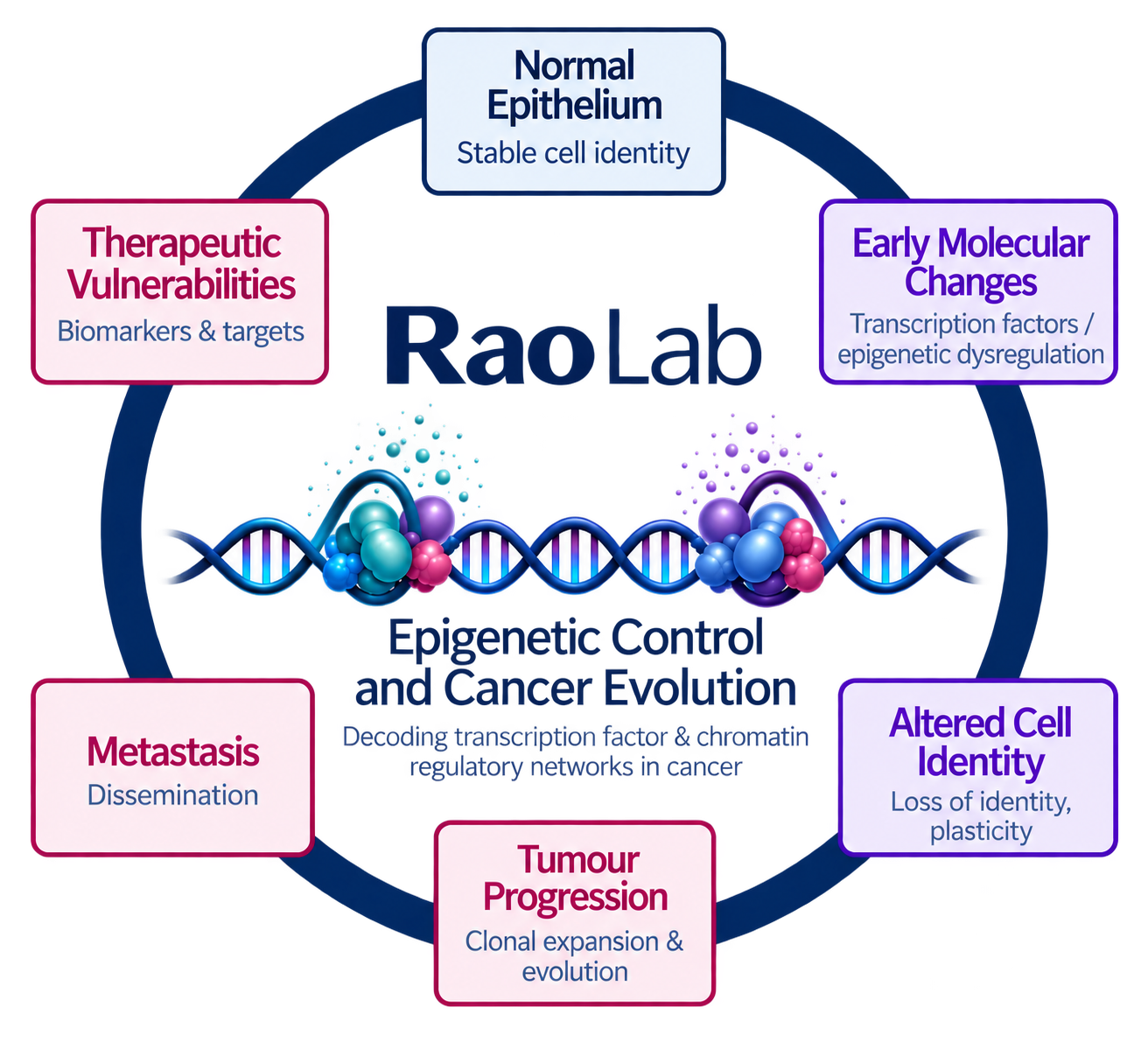
The Rao Lab studies how transcription factor networks and chromatin regulation control epithelial cell identity – and how their disruption drives cancer initiation and progression. We are especially interested in the earliest molecular events of tumour development and how the breakdown of transcriptional programs fuels tumour evolution, cellular plasticity, and therapy resistance.
We take a systematic, functional approach to dissecting cancer regulatory networks, combining transcription factor-focused perturbation screens, CRISPR-based functional genomics, targeted protein degradation (degron) technologies, and integrative genomic and proteomic profiling. These tools are applied across complementary model systems cell lines, genetically engineered mouse models, and patient-derived samples to capture biology at multiple levels of complexity.
A central focus of the lab is defining transcription factor and epigenetic mechanisms in cancers of high unmet clinical need, particularly pancreatic cancer. By mapping the regulatory circuits that establish and maintain tumour cell identity, we aim to uncover the origins of early disease, identify biomarkers of progression, and reveal new therapeutic vulnerabilities for patients with limited treatment options.


Biography
click here to read

Recent Publications
click here to read
Biography
Education and qualifications
- 2011–2015: PhD, NTNU Trondheim, Norway
Appointments
- 2024–present: Assistant Research Professor, CRUK Cambridge Institute, UK
- 2021–2024: Senior Research Associate, CRUK Cambridge Institute, UK
- 2019–2020: Project Lead, Azeria Therapeutics
- 2017–2019: Visiting Scientist, CRUK Cambridge Institute, UK
- 2016–2017: Postdoctoral Fellow, NTNU, Trondheim, Norway
Recent Publications
2026
Pelicano, C., Chernukhin, I., Wölke, M., Cheng, P. S. W. P., Young, L., Edwards, A. R., Mannion, E., Cheng, Y., Crowshaw, M., Kupczak, S., Pinto Teles, S., Jihad, M., Kishore, K., Chilamakuri, C. S. R., Franklin, V. N. R., Papachristou, E. K., D’Santos, C., Grünwald, B., Russell, A., Carroll, J. S., Biffi, G., Rao, S. V. IL-1-activated cancer-associated fibroblasts promote STAT1-driven transcriptional reprogramming of pancreatic tumour cells. Biorxiv.
2025
Rao, S. V., Young, L., Cheeseman, D., Flynn, S., Krebs, N., Couturier, D.-L., Mack, S., Brias, R., Temple, J., Smith, A., Papachristou, E., Pelicano, C., Chilamakuri, C. S. R., Herka, K., Baba, H. A., Farah, L., Cheung, P. F., Siveke, J., Guerrier, S., Insolia, L., Gill, M., Archer-Goode, E., Kupczak, S., Cheng, Y., Borsari, G., Jodrell, D., D’Santos, C., Russell, A., Grünwald, B. T., Serrao, E., Chernukhin, I., & Carroll, J. S. Transcription factor switching drives subtype-specific pancreatic cancer. Nature Genetics. 2025;57:3016–3026.
2024
Martin PL, Pérez-Areoles FJ, Rao SV, Walsh SJ, Carroll JS, Spring DR. Towards the Targeted Protein Degradation of PRMT1. Chem Mechem. 2024 May 9:e202400269
2020
Nagarajan, S, Rao, S.V, Chernukhin, I, Sutton, J, Cheeseman, D, Dunn, S, Papachristou, E.K, Gonzalez Prada, J-E, Couturier, D-L, Kumar, S, Kishore, K, Chilamakuri, CSR, Glont, S-E, Goode, E.A, Brodie, C, Guppy, N, Natrajan, R, Bruna, A, Caldas, C, Russell, A.I, Siersbæk, R, Yusa, K and Carroll, J. S. ARID1A dictates HDAC1/BRD4 activity, intrinsic proliferative capacity and breast cancer treatment response. Nature Genetics. 2020;52:187-197.